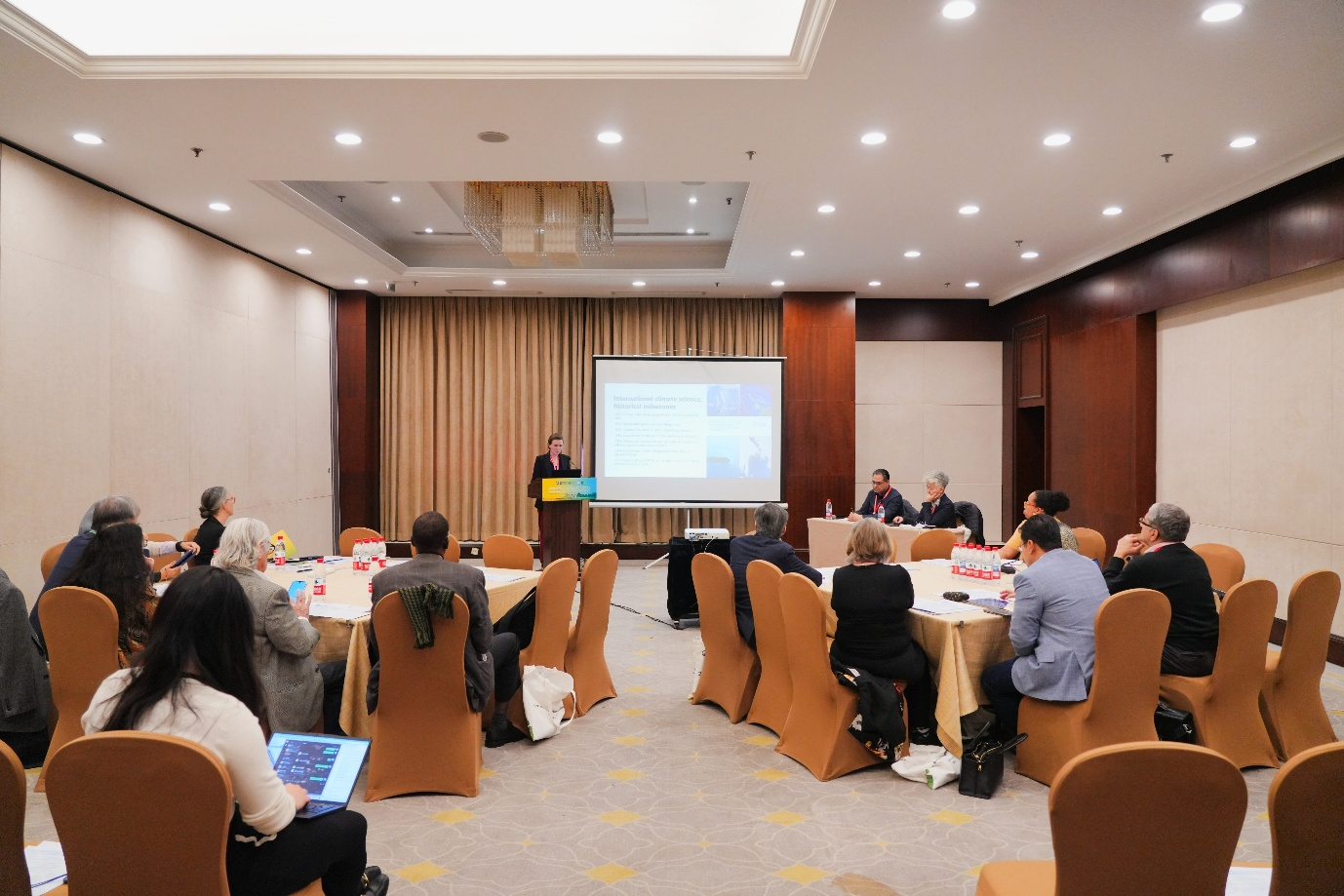
Participants during IRDR's plenary session, “The emerging issues in the international cooperation on climate change and disaster risk” on the last day of the 2nd International Conference on Climate Change and Disaster Risk
On 20 October 2025, IRDR held a parallel session during the 2nd International Conference on Climate Change and Disaster Risk. Held in Beijing, China at the Beijing International Convention Center during the period 18-20 October 2025, the 2nd International Conference explored the impact of climate change on natural hazards, the mechanisms of disaster occurrence and response measures, and disaster risk management to promote in-depth research on climate change and disaster risk, and to enhance social resilience in disaster prevention and mitigation.
IRDR’s plenary session, titled "The emerging issues in the international cooperation on climate change and disaster risk”, addressed the emerging challenges in international scientific cooperation on climate change (CC) and disaster risk reduction (DRR), and fostered dialogue on practical solutions that support inclusive and resilient international scientific collaboration.
Mrs. Anne-Sophie Stevance from the International Science Council (ISC), one of the co-sponsors of IRDR, provided the keynote address titled "International scientific collaboration: Vital yet vulnerable". Mrs. Stevance noted that scientific knowledge and practice should be universally considered a shared resource from which everyone can benefit. Global challenges, however, grow more complex and pose a risk to successful scientific cooperation and collaboration, including lack of international funding mechanisms.
To that end how can the scientific community respond to the urgent need to protect and strengthen global cooperation in science? The participants were divided into two groups and asked to focus their discussions on the following questions:
1) What are successful examples of international scientific collaboration in CC and DRR?
2) What are the key success factors?
3) What are the major barriers?
4) How can developing countries benefit further from international scientific collaboration?
5) How could international scientific collaboration be measured?
6) What are concrete areas and mechanisms for international science collaboration to accelerate the implementation of the Sendai Framework?
Moderated by Mrs. Jenty Kirsch-Wood from the United Nations Office for Disaster Risk Reduction (UNDRR), another of IRDR’s co-sponsors, the participants actively engaged in responding to these questions, drawing attention to:
· successful examples of international collaborations, such as the cooperation between the Chinese Academy of Sciences (CAS) and the National Disaster Management Authority of Pakistan (NDMA) aimed at improving disaster management, especially in Pakistan’s northern mountain regions that are prone to earthquakes and landslides;
· the need for consistent leadership and a visible local champion for scientific collaboration; and
· barriers including funding deficiencies and lack of communication between scientific researchers and policy-makers.
The participants noted that developing countries can benefit greatly from deliberate efforts at transferring technology to the recipient countries and building the capacity of their technical experts in the usage of same. However, there is much work to be done to accelerate the implementation of the Sendai Framework, including greater coordination amongst the many international scientific bodies.
The plenary session was well-received by all participants and re-enforced IRDR's commitment to providing the avenue for mobilising science for the reduction of all types of disaster risk.