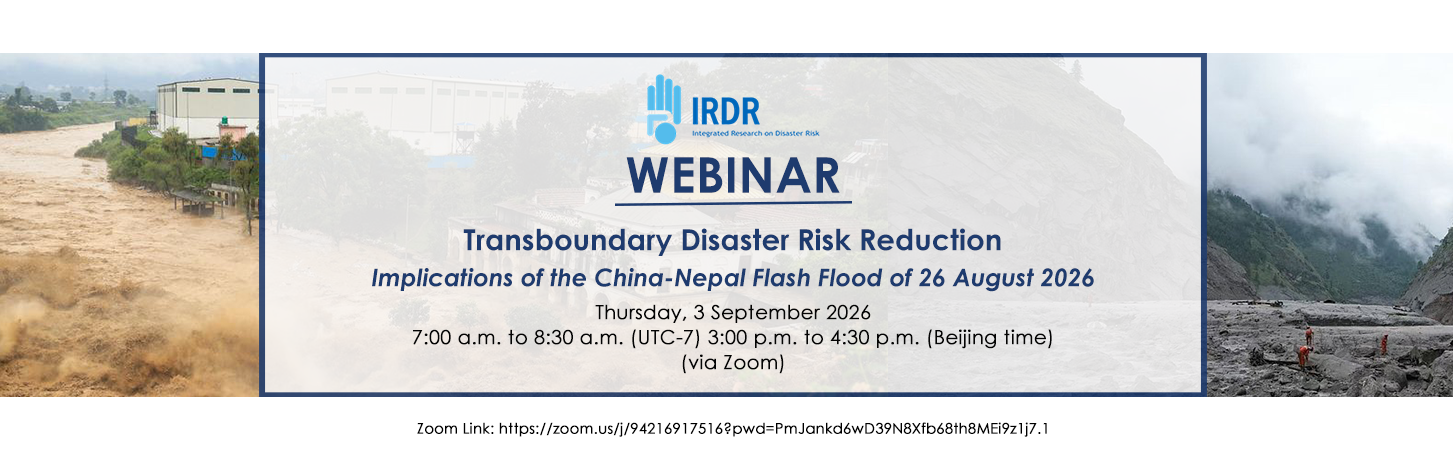
On 26 August 2026, a catastrophic flash flood tore through the Bhotekoshi/Trishuli River corridor, leaving behind a trail of devastation that claimed lives, destroyed critical infrastructure, and severed vital transport links. The disaster was set in motion by a massive ice-rock avalanche originating from a collapsing glacier section on the northwestern slopes of Nepal's Langtang Himal. The resulting debris cascade temporarily dammed the river; when the natural dam breached, it unleashed a violent torrent of water and sediment that swept through downstream communities, hydropower installations, and border facilities.
This event is more than a tragedy—it is a critical inflection point for transboundary disaster risk governance in the Hindu Kush Himalaya. It has laid bare persistent systemic weaknesses: early warning systems remain fragmented along national borders, real-time data sharing between affected countries is hampered by a lack of effective mechanisms, and governance frameworks designed for single hazards are overwhelmed by the cascading, multi-hazard nature of high-mountain events.
Workshop Objectives and Thematic Priorities
In response to this urgent challenge, the Integrated Research on Disaster Risk (IRDR) programme has convened a high-level virtual workshop to dissect the 26 August event as a definitive case study and to chart a forward-looking course for transboundary resilience.
The workshop is designed to achieve five strategic outcomes:
Analyze the 26 August 2026 event as a benchmark for cascading transboundary hazards in the Himalayan region.
Identify systemic gaps in current early warning protocols, risk assessment frameworks, and cross-border coordination mechanisms.
Articulate a compelling, evidence-based rationale for enhanced international investment in science and technology for transboundary DRR.
Foster stronger multi-stakeholder collaboration among UN agencies, academic and research institutions, government bodies, and frontline practitioners.
Develop actionable policy and operational recommendations to strengthen transboundary resilience and promote risk-informed development.
Core thematic priorities guiding the discussions include:
Multi-Hazard Early Warning Systems (MHEWS): Integrating seismic, cryospheric, and hydrological monitoring across the entire source-to-downstream continuum.
Critical Infrastructure Risk Assessments: Covering hydropower projects, cross-border transport corridors, and frontier facilities.
Capacity Building for DRR Research and Community Resilience: With a dedicated focus on high-risk, transboundary catchments.
Distinguished Speakers and Agenda
The 90-minute online event brings together a distinguished roster of experts and practitioners from across the globe. The agenda is structured to maximize expert engagement and actionable outcomes.
Opening Remarks will be delivered by Marco Toscano-Rivalta, Chief of the UNDRR Regional Office for Asia and the Pacific, and Saini Yang, IRDR's Executive Director, setting the tone for regional and international collaboration.
Scientific Briefings will provide rapid-response insights and ground-level observations. Suraj Gautam (IRDR ICoE on Interdisciplinary Research on Himalayan Risk and Resilience – ICoE-IHRR) will offer scientific context, while Hao Wang (Institute of Mountain Hazards and Environment, Chinese Academy of Sciences) will present geophysical assessments from the field.
A Panel Discussion will feature contributions from:
Amod Dixit (IRDR ICoE-NSET, Nepal) – Emergency response, post-event lessons, and science-policy integration.
Suraj Gautam and Basanta Raj Adhikari (IRDR ICoE-IHRR) – GLOF dynamics, cascading hazard modeling, citizen science, and operational early warning frameworks.
Emily Chan (IRDR ICoE for Disaster and Medical Humanitarian Response – CCOUC) – Health Emergency and Disaster Risk Management (HEDRM) and transboundary public health capacity building.
Rajib Shaw (IRDR Fellow) and Yu Lei (Scientific Committee Member) – Strategic science support for DRM authorities and visionary perspectives on MHEWS and risk-informed development.
[Speaker tbc] from the International Centre for Integrated Mountain Development (ICIMOD) – Climate resilience and sustainable mountain development in the Hindu Kush Himalaya.
The session will conclude with an Open Floor Q&A and Wrap-Up and Next Steps, delivered by IRDR's Executive Director.
Join the Conversation
This workshop is a timely opportunity for senior representatives from UN agencies, research institutions, government bodies, civil society, and media to engage with global and regional experts on one of the most pressing transboundary disaster challenges of our time. Participants will gain insight into the latest scientific findings, practical perspectives on early warning and infrastructure resilience, and access to a network of DRR leaders shaping policy and practice in the Himalaya and beyond.
Event Details
Date: Thursday, 3 September 2026
Time: 7:00 a.m. to 8:30 a.m. (UTC-7) 3:00 p.m. to 4:30 p.m. (Beijing time)
Format: 90-minute online workshop via Zoom
Zoom Link: https://zoom.us/j/94216917516?pwd=PmJankd6wD39N8Xfb68th8MEi9z1j7.1
No prior registration is required—participants may join directly via the link above.
About the Organizers
This event is convened by IRDR, in collaboration with its International Centres of Excellence and key partners, including UNDRR and ICIMOD.
The concept note for this webinar can be read here.
For further information, please contact: Ms. Fang Lian, IRDR's Science Officer, at fang.lian@irdrinternational.org.