On Tuesday, 1 September 2026, IRDR successfully hosted its online workshop, "Climate Change and Public Health: Connecting IRDR Research Teams". The 90-minute webinar brought together researchers from across the IRDR network and its partners to share progress, exchange knowledge, and explore new avenues for collaboration within one of IRDR's key workstreams: climate change and public health.
Presentations
The session featured a series of brief presentations highlighting ongoing research and innovative approaches:
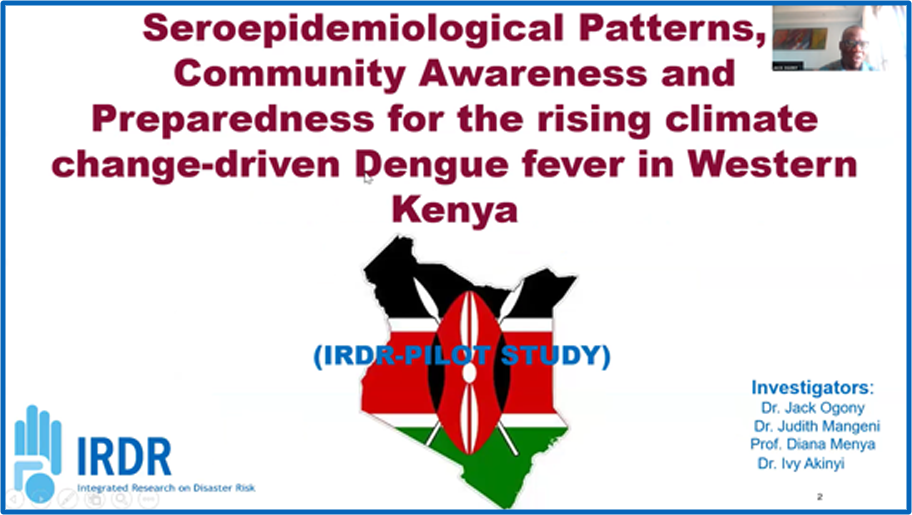
Dr. Jack Ogony, Principal Investigator for the IRDR ICoE-REaL-affiliated pilot study, "Seroepidemiological Patterns and Community Preparedness for Climate Change-Driven Mosquito-Borne Diseases in Flood-Prone Areas of Western Kenya", provided an update on the project’s status. Dr. Ogony detailed the study's methodology, which includes clinical examinations and testing at health facilities, followed by community-focused group discussions to assess serotype distribution and community preparedness. Dr. Ogony advised that he and the members of his team are now awaiting ethical approval to proceed with data collection, having already initiated procurement of necessary materials. The other members of the team are Dr. Judith Mangeni, Prof. Diana Menya, and Dr. Ivy Akinyi.
Prof. Emily Ying Yang Chan, Director of the IRDR ICoE for the Collaborating Centre for Oxford University and CUHK (CCOUC) for Disaster and Medical Humanitarian Response (IRDR ICoE-CCOUC), offered insights into CCOUC's role as a platform for research, education, and community knowledge transfer in disaster and medical humanitarian crisis policy development, planning, and response. Her presentation also covered CCOUC's partnership with Hong Kong's GX Foundation, implementing preventive measures across 14 countries—including rapid dengue tests, mosquito traps, and education programmes in infrastructure projects such as the Lao-China Railway.
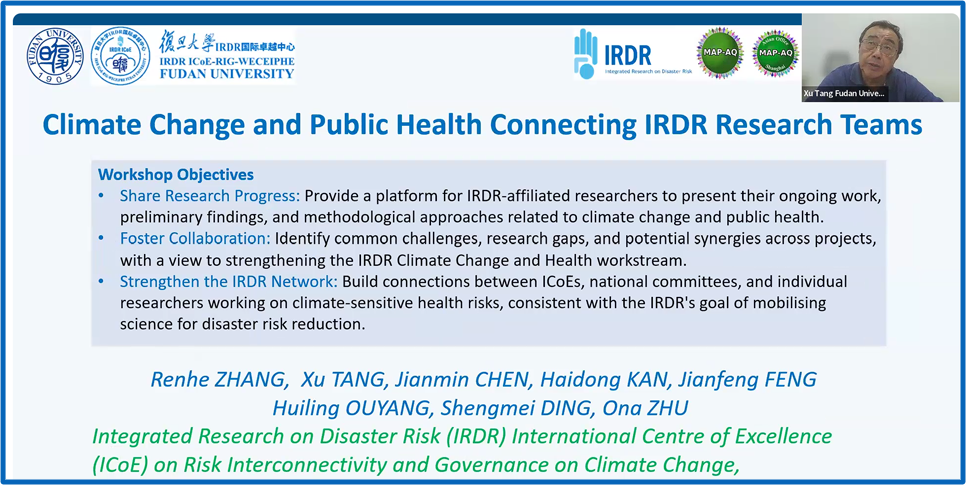
Prof. Xu Tang, Director of the IRDR ICoE on Risk Interconnectivity and Governance on Climate Change (IRDR ICoE-RIGCC), hosted by Fudan University, presented their five-year framework for addressing climate change and public health. He highlighted key activities, including the development of an all-course atlas, global collaboration networks, and the launch of the AI Service Plus initiative. Professor Tang concluded with information about Fudan's laboratory network, which currently includes 15 cities with official collaboration commitments and plans to expand into Africa.
Prof. Peng Bi, an internationally recognised environmental epidemiologist from the University of Adelaide, provided an overview of his team’s 25-year research programme in Australia. His research sits at the intersection of climate change, environmental and occupational health, ecosystem health, and infectious disease epidemiology. He focused on health risk assessment, community engagement, and the successful implementation of a heat and health early warning system.
Prof. Qunshan Zhao, Deputy Director of the Urban Big Data Centre at the University of Glasgow, presented the centre's work in urban research, focusing on data infrastructure development and spatial optimisation methodologies. He detailed their IDMAPS project, which creates a digital platform for mapping deprivation in African cities such as Nairobi, Lagos, and Kano through co-designed models covering morphological informality, healthcare access, and other deprivation domains.
Key Takeaway
The ensuing discussion revealed strong potential for collaboration, particularly between IRDR ICoE-CCOUC/GX Foundation and Dr. Ogony's dengue research, as well as among Australian and UK institutions on heat, productivity, and data platforms. All participants expressed keen interest in future joint projects and continued exchanges.
The workshop served as a vital platform for connecting IRDR research teams and reaffirmed the programme's commitment to mobilising science for a safer, more resilient world.