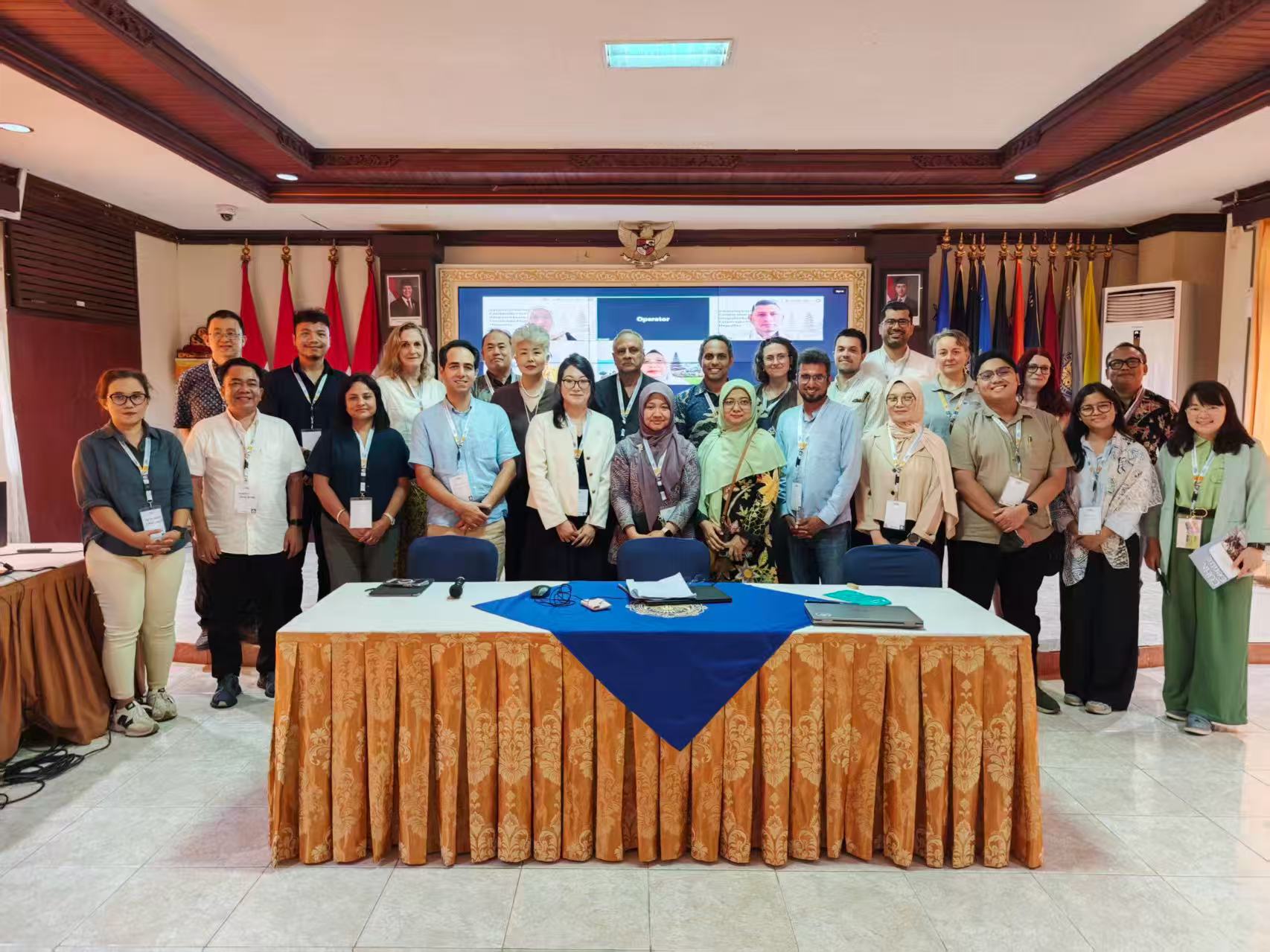
Particpants at the IRDR Special Session at IDRiM 2026
The IRDR Special Session at the recently held 16th IDRiM Conference 2026, “Advancing International Collaboration to Foster Integrated Research on Catastrophe Resilience in Megacities”, brought together leading researchers and institutions to address the growing disaster risk in the world's most populous urban centres. The session opened with remarks from Dr. Luki Subehi, Head of Research of the Organization of Earth Sciences and Maritime at Indonesia's National Research and Innovation Agency (BRIN) and Director of the newly designated IRDR ICoE for Disaster Risk Reduction and Resilience Research (IRDR ICoE-D4R), and Prof. Saini Yang, IRDR’s Executive Director.
Presentations from the British Geological Survey (BGS), BRIN, Japan's National Research Institute for Earth Science and Disaster Resilience (NIED), and Nepal's Institute of Himalayan Risk Reduction (IHRR) converged on four common themes.
Megacities as interconnected systems of systems. Speakers emphasised that power, water, transport, telecommunications, and health systems fail in cascading, nonlinear ways. Er. Suraj Gautam (IHRR/IRDR ICoE-IHHR) showed how risk travels downstream from the Hindu Kush Himalaya through watersheds and infrastructure to megacities, while Dr. Nuraini Rahma Hanifa (BRIN/IRDR ICoE-D4R & IRDR Scientific Committee member) demonstrated through the ISPF "Exposed" project in Bandung, Indonesia how geohazard scenarios interact with social and physical exposure.
The technical frontier—opportunities and limits. Dr. Ekbal Hussain (BGS) identified high-resolution multi-hazard modelling, digital twins, new observation platforms, and AI/ML as transformative, but cautioned that "data does not equal information," stressing shared data standards and open data governance. Dr. Hanifa showcased Indonesia's SATREPS End-to-End Earthquake Early Warning and Response System and school-based multi-hazard early warning.
From hazard to systemic risk—the science-policy-practice gap. Dr. Shohei Matsuura (NIED) presented the Science Council of Japan's April 2026 recommendation proposing an STI platform linking scientists, policymakers, communities, and the private sector. Gautam called for moving "from hazard maps to systemic risk" and "from static assessments to dynamic intelligence," with citizens as monitoring partners.
Early warning must lead to early action. Dr. Hanifa presented the "Schools as Anchor" initiative for seamless earthquake, tsunami, and storm surge early warning in coastal Indonesian schools, aligned with the Sendai Framework and the UNESCAP/UNESCO/UNDP safe school roadmap.
Capacity building, youth, and inclusivity were recognised as essential, with Hanifa calling for access to emerging technologies for local government, community leaders, women, youth, and people with disabilities. The 3rd International Workshop of Youth and Young Professionals, with 100 participants from 14 countries, exemplified this commitment.
The International Platform for Risk-Informed and Megacity Resilience
A centrepiece of the session was the soft launch of an International Platform for Risk-Informed Development and Megacity Resilience, under the IRDR Work Stream on Risk-Informed Development. Initial partners include IRDR, three IRDR ICoEs (IRDR ICoE-Coherence, IRDR ICoE-D4R, and IRDR ICoE-IHRR), NIED (Japan), BRIN (Indonesia), IHRR (Nepal), and BGS (UK). The platform aims to facilitate knowledge exchange, foster comparative research, connect science with policy and practice, and mobilize complementary resources.
Read more about the The International Platform for Risk-Informed and Megacity Resilience here.
An Invitation to Build Together
The session concluded with an open invitation to researchers, institutes, universities, international organizations, practitioners, cities, and multi-stakeholders to contribute their expertise, initiatives, networks, and resources. As the organizers emphasised, "Together, we can advance risk-informed development and resilience in megacities and beyond."