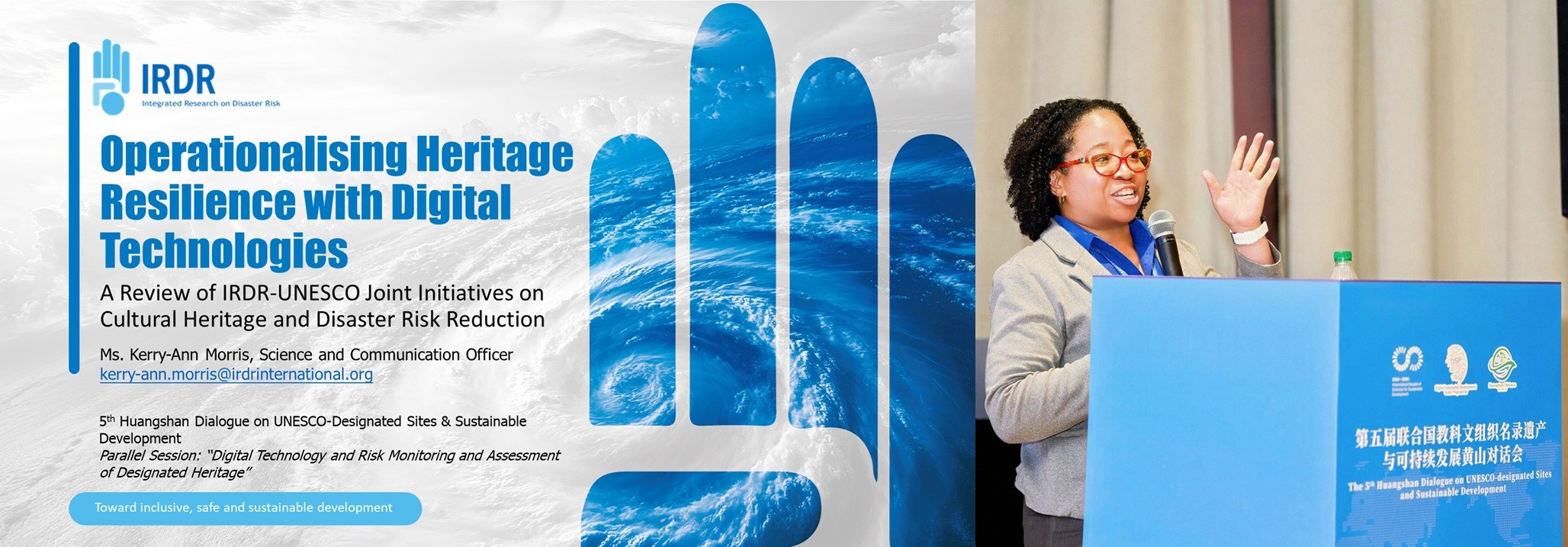
At the 5th Huangshan Dialogue on UNESCO-designated Sites and Sustainable Development, the Integrated Research on Disaster Risk (IRDR) programme presented a review of its ongoing partnership with UNESCO during a parallel session titled "Digital Technology and Risk Monitoring and Assessment of Designated Heritage". The presentation, delivered by Ms. Kerry-Ann Morris, Science and Communication Officer at IRDR, highlighted three concrete initiatives that demonstrate how science-policy collaboration can operationalise digital technologies for the protection of UNESCO-designated sites.
IRDR and UNESCO have created a strategic partnership to bridge a critical gap: integrating disaster risk reduction (DRR) into the conservation and management of designated heritage, while promoting culturally-sensitive approaches aligned with the Sendai Framework for Disaster Risk Reduction 2015-2030. Ms. Morris focused on three complementary streams of joint activity.
Initiative One: Co-Published Research
In August 2025, IRDR and UNESCO launched the publication Intangible Cultural Heritage Safeguarding and Climate Action in Asia and the Pacific, developed with UNESCO Category 2 Centres—the International Research Centre for Intangible Cultural Heritage in the Asia-Pacific Region (IRCI) and the International Information and Networking Centre for Intangible Cultural Heritage (ICHCAP). The volume draws on case studies from Sri Lanka, Mongolia, Bangladesh, and Vanuatu, demonstrating that while climate change directly threatens living heritage, the same traditions and knowledge also offer community-based resilience solutions.
While not directly focused on digital technologies, Ms. Morris emphasised that the publication establishes the evidence base for technological support for risk monitoring of UNESCO-designated heritage sites.
Initiative Two: Joint Forums
In April 2025, IRDR and UNESCO co-organised a sub-forum, titled “International Cooperation for Climate Change”, at the 2025 Disaster Risk Reduction Conference held in Hangzhou, China. The event brought together 10 East Asian universities to define four priority research areas for culture-DRR integration. Among these was the application of digital technologies for risk monitoring and assessment, specifically, the use of artificial intelligence (AI), the Internet of Things (IoT), and remote sensing for all-weather, real-time dynamic monitoring of designated heritage sites, post-disaster damage assessment, and integration with early warning systems.
Ms. Morris noted that these are operational pathways that technology developers, heritage authorities, and DRR practitioners can implement together.
Initiative Three: Skills Development
In August 2025, IRDR and UNESCO co-organised the 3rd IRDR Young Scientists Lumos webinar under the theme "Cultural Heritage Meets Resilience". Four early-career researchers presented innovations ranging from traditional environmental forecasting in South Asia to a video game designed to build cultural and environmental awareness. This initiative focused on building the next generation of researchers working at the intersection of digital technology and heritage risk assessment.
A Replicable Model for Science-Policy Partnership
Ms. Morris outlined how these three initiatives form an integrated, replicable model. Research provides the scientific evidence. Joint forums translate evidence into policy dialogue and priority areas. Skills development builds human capacity and cultivates future researchers. The model is designed to be adopted by any research institution working on risk monitoring of designated heritage, requiring only intellectual capital and convening power—not extensive logistics or local infrastructure.
About the 5th Huangshan Dialogue
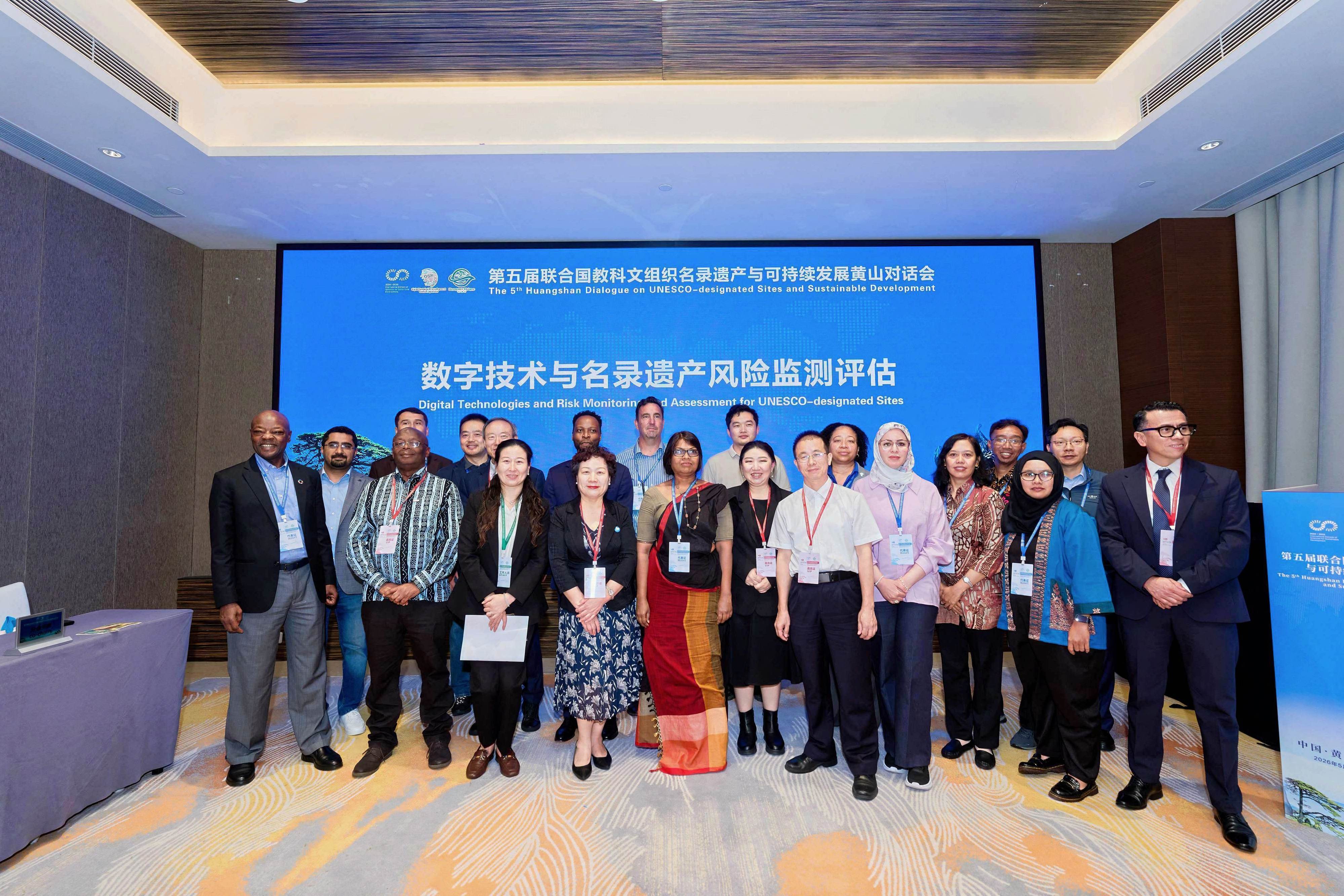
The Huangshan Dialogue is a premier international forum focused on the sustainable development of UNESCO-designated sites. The 5th Dialogue brought together researchers, policymakers, and practitioners from across the world to explore the theme "Digital Technologies Driving Sustainable Development of UNESCO-designated Sites."
IRDR supports the Huangshan Dialogue as a key platform for advancing science-policy collaboration to integrate DRR into heritage conservation and management.