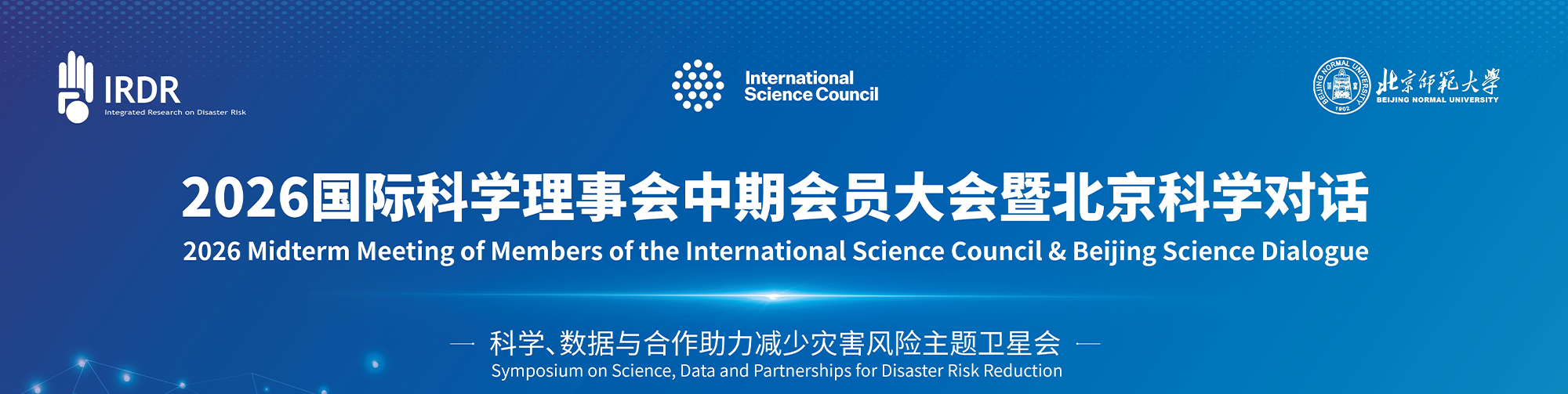
As part of the 2026 Beijing Science Dialogue, the Integrated Research on Disaster Risk (IRDR) programme will host a full-day satellite symposium on Science, Data and Partnerships for Disaster Risk Reduction on 20 October 2026 at Beijing Normal University. The event will bring together leading researchers, policymakers, and practitioners from across the globe to examine how scientific knowledge, data, and international research partnerships can strengthen disaster risk reduction (DRR) in a rapidly changing world.
Held alongside the 2026 Midterm Meeting of Members of the International Science Council (ISC), the symposium will advance the Sendai Framework for Disaster Risk Reduction and the 2030 Agenda for Sustainable Development. Across four thematic panels, participants will explore the economic dimensions of disaster risk, the role of data and technology, the nexus of climate change and disaster losses, and the complex interdependencies between human and natural systems.
The full agenda for the symposium can be read here.
Opening Session and Launch
The symposium will open with welcoming remarks from Jihong Yu, President of Beijing Normal University; Peter Gluckman, President of the International Science Council; and Marco Toscano-Rivalta, Head of the Regional Office for Asia and the Pacific at the United Nations Office for Disaster Risk Reduction (UNDRR). The session will be chaired by Ming Wang, Vice-President of BNU.
Saini Yang, Executive Director of IRDR, will then formally launch the symposium, setting the stage for a day of interdisciplinary dialogue on how science and data can inform risk-informed decision-making.
Panel I: Economics of Disasters and Disaster Risk Reduction
Economics and the economic sciences will play a foundational role in DRR by transforming natural hazards from unpredictable crises into quantifiable economic and financial risks. This panel will examine how analytical frameworks and metrics can help governments and organizations justify investments in resilience, allocate scarce resources efficiently, and design sustainable recovery strategies.
Chaired by Alik Ismail-Zadeh (Karlsruhe Institute of Technology, Germany, and Chair of IRDR's Scientific Committee), the session will feature a keynote address by Lars Hansen (University of Chicago, USA), 2013 Nobel Laureate in Economic Sciences. Panelists will include Qiuming Chen (China University of Geosciences, China), Stéphane Hallegatte (World Bank Group, USA), Rajib Shaw (Keio University, Japan, and IRDR Fellow), Marco Toscano-Rivalta (UNDRR, Thailand), and Junhua Zhou (China Re Catastrophe Risk Management Co., Ltd., China). Yongsheng Yang (BNU) will serve as rapporteur.
Expected outcomes: The panel will enhance understanding of cost-benefit analysis, macroeconomic modelling tools, and disaster risk financing and insurance mechanisms that can strengthen DRR investments and recovery planning.
Panel II: Data and Technology for Disaster Risk Reduction
While data and technological innovations will offer considerable potential for hazard prediction and DRR, their effectiveness will be constrained by persistent challenges including limitations in data quality and interoperability, the digital divide, and an overreliance on digital systems. This panel will explore how integrated knowledge systems and interdisciplinary collaboration can enhance the science–policy interface.
Chaired by Yu Lei (China-Pakistan Joint Research Centre on Earth Sciences, and member of IRDR's SC), the session will feature a keynote address by Virginia Murray (University College London, UK and IRDR Fellow). Panelists will include Orhan Altan (Istanbul Technical University, Türkiye), Burçak Başbuğ Erkan (Middle East Technical University, Türkiye), Amod Mani Dixit (National Society for Earthquake Technology, Nepal, and Director of IRDR ICoE-NSET), Qiuhua Liang (Loughborough University, UK, and Director of IRDR ICoE-IDR), Peijun Shi (Expert Committee of the National Disaster Risk Reduction Commission, China), and Siquan Yang (National Institute of Natural Hazards, China). Junzhi Liu (BNU) will serve as rapporteur.
Expected outcomes: The panel will identify strategies to overcome data quality and interoperability barriers, bridge the digital divide, and integrate technology with capacity-building and community engagement for demand-driven DRR solutions.
Panel III: Climate Change and Disaster Risk Reduction
The nexus of climate change adaptation and DRR will face significant challenges driven by complex scale mismatches, fragmented governance structures, and siloed funding mechanisms that will remain skewed toward reactive disaster response. This panel will examine how interdisciplinary scientific approaches can bridge the gap between climate projections and context-specific DRR interventions.
Chaired by Irasema Alcántara-Ayala (National Autonomous University of Mexico, Mexico, and IRDR Fellow), the session will feature a keynote address by Deliang Chen (Future Earth / Tsinghua University, China). Panelists will include Bapon Fakhruddin (Green Climate Fund, Republic of Korea, and IRDR Fellow), Maria Soledad Garcia Ferrari (University of Edinburgh, UK, and IRDR SC member), Josephine K. Ngaira (Masinde Muliro University of Science and Technology, Kenya, and IRDR SC member), Peng Cui (Chinese Academy of Sciences, China, and IRDR Fellow), and Robert Walker (Oxford University, UK / BNU, China). Zhengtao Zhang (BNU) will serve as rapporteur.
Expected outcomes: The panel will improve understanding of how integrated natural, social, and data sciences can anticipate, withstand, and recover from increasingly complex climate-related hazards, and how to overcome governance and funding barriers to proactive risk reduction.
Panel IV: Systemic, Compound and Cascading Risks
Understanding systemic, compound, and cascading risks will remain a significant challenge due to the complex interdependencies between human and natural systems. Key obstacles will include the limitations of conventional risk management approaches in representing low-probability, high-impact event chains, the scarcity of historical data for rare hazards, and uncertainties regarding how localized failures propagate into large-scale disruptions.
Chaired by Saini Yang (IRDR/BNU, China), the session will feature a keynote address by Louise K. Comfort (University of California, Berkeley, USA). Panelists will include Amir AghaKouchak (University of California, Irvine, USA), Emily Ying Yang Chan (Chinese University of Hong Kong / GX Foundation, China, and Director of IRDR ICoE-CCOUC), Ilan Noy (Victoria University of Wellington, New Zealand), John Handmer (International Institute for Applied Systems Analysis, Austria), Ronald Roopnarine (The University of the West Indies, Trinidad and Tobago, and IRDR SC member), and Kai Liu (BNU, China). Xiaoyong Ni (BNU) will serve as rapporteur.
Expected outcomes: The panel will advance complex systems modelling, AI-based simulation of critical infrastructure interdependencies, multi-hazard risk assessments, scenario development for cascading events, and vulnerability mapping to identify socio-economic tipping points and protect the most vulnerable.
Concluding Remarks: Science for the Post-2030 Sendai Framework
The symposium will conclude with a forward-looking session on the role of science in the Post-2030 Sendai Framework and other UN agendas. Co-chaired by Irasema Alcántara-Ayala, Alik Ismail-Zadeh, Ming Wang, and Saini Yang, the session will synthesize the outcomes of the day's discussions and outline key messages for the international DRR and sustainability community.
Expected outcomes: The session will produce a consolidated set of recommendations and scientific insights to inform the Post-2030 Sendai Framework and strengthen the science-policy interface for disaster risk reduction globally.
Scientific Facilitation Visit
During the lunch break, participants will be able to join an optional Scientific Facilitation Visit to two leading research facilities at Beijing Normal University: the State Key Laboratory of Cognitive Neuroscience and Learning and the State Key Laboratory of Earth Surface Processes and Disaster Risk Reduction, including the Geological Specimen Museum of Beijing Normal University.
Organizers and Support
The symposium is being organized by IRDR and Beijing Normal University, with support from the ISC, the United Nations Office for Disaster Risk Reduction (UNDRR), the China Association for Science and Technology (CAST), the Chinese Academy of Sciences (CAS), and numerous international scientific unions.
The agenda for IRDR's Satellite symposium is available here: https://www.irdrinternational.org//upload/20261016/7b80dece82a026.pdf
For more information about the 2026 Beijing Science Dialogue and the ISC Midterm Meeting of Members, visit the ISC website: https://council.science/mmm-beijing-science-dialogue/